


The wisdom tooth is the last to erupt of all. the teeth we have in the oral cavity. Wisdom teeth do not present aesthetic problems, being positioned behind the usual molars, but they can usually cause problems or complications and need to be extracted.
The wisdom tooth is a normal tooth, except that as it's the last to appear, it often can't find space on the dental arch. Our jaws are smaller than those of our ancestors, and the space for the third molar has reduced. Because of this, eruption can be incomplete or in the wrong direction.
In practice, most patients consult a doctor due to pain or inflammation. Sometimes, the problem resolves with treatment and careful hygiene. Other times, extraction is the solution. Everything depends on the tooth's position, symptoms, and long-term risks.
Their role is the same as that of other molars: they help you chew food. In practice, they are not essential. You can eat perfectly normally without them, and from an evolutionary perspective, they are considered teeth that are gradually losing their usefulness.
Problems arise when there isn't enough space in the dental arch. In this case, the tooth can remain trapped in the bone or under the gum, grow at an angle, or push against a neighbouring tooth. Situations like these frequently lead to pain, inflammation, or infection.
What is a wisdom tooth and how many wisdom teeth does a person have?
The wisdom tooth is the third molar on each dental arch, meaning it's the last tooth at the back. Normally, an adult can have up to four wisdom teeth: two on the top and two on the bottom. However, not everyone has all of them. Some people only have one or two, and others don't develop these molars at all.
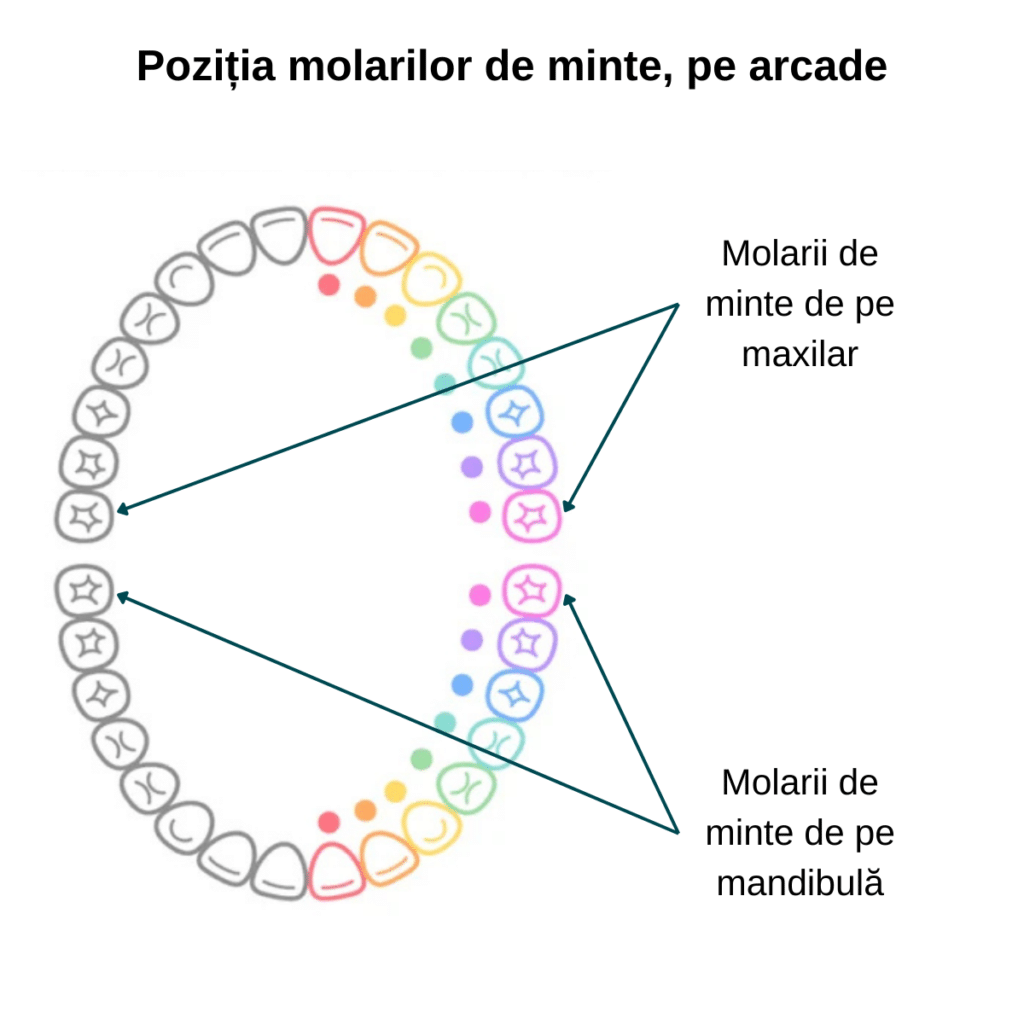
Their role, in theory, is the same as other molars: they help chew food. In reality, their function is quite limited. Most people can eat normally even without these teeth, and from an evolutionary standpoint, they are considered „receding” teeth.
Problems arise when there isn't enough space in the dental arch. In this case, the molar may become impacted in the bone or under the gum, it may grow at an angle, or it may push against the neighbouring tooth. Situations of this kind frequently lead to pain, inflammation, or infections and are the main reasons why a dentist recommends extraction.
The age at which wisdom teeth come through
Generally, wisdom teeth start to erupt between the ages of 17 and 25. This is where the popular name comes from, as they appear at the age when, theoretically, you reach maturity.
However, this timeframe is approximate. You can have wisdom teeth that appear earlier or much later, even after 30 or 40 years of age. It is equally normal for them not to appear at all.
The eruption can last for months or even years. During this time, the tooth may remain partially covered by the gum, and the area becomes difficult to clean. Food debris and bacteria can accumulate there, increasing the risk of inflammation or infection.
Symptoms that accompany the eruption of wisdom teeth: pain, the most common sign of a wisdom tooth
The most common sign is pain at the back of the mouth. Sometimes you'll feel only slight discomfort, while other times a throbbing pain will develop, spreading towards the ear or temple. The surrounding gum tissue may become red, swollen, and tender.
Besides pain, you may notice difficulty opening your mouth or chewing. Sometimes there is constant pressure in the molar area, especially if there is not enough space for eruption. In more severe cases, you may have a slight fever or swollen lymph nodes.
There are also situations where you don't feel anything. The tooth emerges completely into the arch and functions normally. This is precisely why regular check-ups are important, because some problems appear without obvious signs.
De ce apar probleme cu măseaua de minte?

The wisdom tooth can cause problems for several reasons, including:
- Limited space Some people may have a smaller oral cavity than the normal size for wisdom teeth, which can lead to them becoming impacted. When a wisdom tooth cannot erupt fully or is blocked under the gum, it can cause discomfort, swelling, and infection.
- Incorrect posture Wisdom teeth can erupt in an improper position, either due to limited space or genetic factors. This can lead to impaction, where the wisdom tooth presses against the adjacent tooth, or partial eruption, which can facilitate the build-up of plaque and cavities. To determine the exact situation, further investigations are required X-rays and investigations, so that the dentist can make a treatment proposal.
- The difficulty of dental hygiene: The back position of the mouth makes wisdom teeth difficult to clean properly. This can lead to the build-up of plaque and the development of cavities or gingivitis in the wisdom tooth area.
- Structural problems: Wisdom teeth can have an improper structure or can be affected by tooth decay, fractures, or other dental problems. These problems can cause pain, inflammation, and other unpleasant symptoms.
- Problems associated with eruption: The eruption of wisdom teeth can be accompanied by various symptoms, such as discomfort, swelling of the gums, and a feeling of pressure in the back of the mouth. These symptoms can be unpleasant and may affect daily quality of life.
Wisdom tooth decay
Tooth decay frequently occurs with wisdom teeth precisely because the area is difficult to clean. Being positioned at the back of the mouth, the toothbrush has more trouble reaching there, and plaque remains on the tooth surface for longer. If the tooth is semi-impacted or tilted, food debris can get trapped between it and the adjacent molar, making cleaning even more difficult. Over time, bacteria attack the enamel and decay appears, which may initially progress without clear symptoms.

As decay progresses, sensitivity to cold, sweet or chewing may occur, and sometimes the pain radiates to the ear or temple. The problem is that access for treatment is limited, especially if the tooth is positioned crookedly or very far back. In many cases, the dentist may recommend extraction instead of treatment, because the chances of recurrence are high and long-term hygiene remains difficult. If it is early decay, treatment can be a good option. The decision is always made after an X-ray, which shows how affected the tooth is and whether it is worth saving.
Wisdom tooth and earache
If your ear is hurting and you simultaneously feel discomfort behind your mouth, it's very possible that the source is your wisdom tooth. It doesn't automatically mean you have an ear infection, but rather that the pain can travel along the same nerve pathways. The lower molar area, the jaw joint, and the ear are neighbours and have nerve connections that can easily fool the brain. This is why sometimes you might feel like your ear is hurting when, in fact, the problem originates from your gum or tooth.
Earache associated with a wisdom tooth often occurs when the tooth erupts crookedly, is partially impacted, or has inflamed the surrounding gum. You might feel a dull, deep ache that intensifies when chewing, yawning, or trying to open your mouth wider. Sometimes, the pain spreads to the temple or neck, making things even more confusing. If you also experience an unpleasant taste, bad breath, or a swollen gum at the back, the clues point even more strongly to a wisdom tooth.
If the pain persists for a few days, gets worse, or a fever develops, it’s a good idea to see a dentist quickly, as an inflammation behind the molars can become complicated. And if a dental check-up doesn’t confirm the cause, only then does it make sense to go for an ENT (ear, nose, and throat) check-up, so as not to misdiagnose pain that actually originates elsewhere.
When and why wisdom teeth need to be removed
If the tooth has fully erupted, is correctly aligned, and you can clean it easily, the dentist will advise you to keep it. A wisdom tooth should be removed when persistent pain occurs, if it pushes against a neighbouring tooth, causes crowding of the teeth, or remains trapped under the gum.
Sometimes, extraction is done preventatively. If the X-ray shows that the wisdom tooth has a position which could affect nearby nerves or teeth, or becomes impossible to clean effectively, your dentist may recommend removing it before complications arise. This can include:
- Impact Wisdom teeth can become impacted, meaning they remain trapped under the gum or erupt only partially. This can lead to pain, swelling, infection, and damage to the neighbouring tooth.
- Difficulty maintaining dental hygiene Due to their position at the back of the mouth, wisdom teeth can be difficult to clean properly. This can lead to the build-up of plaque and tooth decay, which can affect the health and integrity of other teeth.
- Dental caries or damage: Wisdom teeth, being difficult to clean, are often more susceptible to tooth decay and damage. If wisdom teeth have extensive decay or other structural problems, their extraction may be necessary.
- Chronic discomfort Some people may experience chronic discomfort or pain in the wisdom tooth area, even in the absence of other obvious problems. In these cases, wisdom tooth extraction may be considered to eliminate the discomfort and improve quality of life.
Generally, the extraction of wisdom teeth is recommended when they cause discomfort or pose a risk of causing dental problems or future complications. It is important to consult a dentist for proper evaluation of wisdom teeth and to determine if their extraction is necessary.
Dr. Sabina Iftimi, a specialist in dento-alveolar surgery at Dental Elite, explains in detail, from her own experience, why extraction is sometimes necessary:
”Sometimes it's necessary, other times we can leave them there. It depends on several factors. Normally and recently, according to phylogenetic evolution, most of us are born without wisdom tooth buds. But I'm seeing more and more patients who come with wisdom teeth in very unnatural positions. In horizontal positions, completely impacted or partially impacted. In these cases, to avoid certain complications, both mechanical and infectious, the extraction of wisdom teeth is most often recommended.
Stages of the wisdom tooth extraction procedure
Everything starts with a careful evaluation and a dental X-ray. The dentist checks the position of the molar, its relation to adjacent teeth and nerves, and then determines the type of procedure. Depending on the case, Wisdom tooth extraction it can be simple or more complex.
At Dental Elite, the procedure is always carried out under local anaesthetic, so you won't feel any pain. Once the area is completely numb, the dentist begins the actual procedure. After the tooth is removed, the area is cleaned, and if necessary, stitches are applied. You will receive clear instructions for the recovery period and sometimes medication for pain or inflammation.
Wisdom tooth extraction is a surgical procedure and can be performed under local or general anaesthetic, depending on the complexity of the case and the patient's preference. The extraction process can vary depending on the position and condition of the wisdom tooth, but generally, the following steps are often followed:
- AnaesthesiaBefore extraction, local anaesthetic is administered to numb the area around the wisdom tooth and prevent discomfort or pain during the procedure. In some cases, general anaesthetic may be necessary for more complex procedures or for patients with severe anxiety.
- Tissue separation: The dentist or oral surgeon will use a special instrument to separate the gum and expose the wisdom tooth and its root. If the wisdom tooth is impacted, a larger incision in the gum may be necessary to access the tooth.
- Tooth extraction Once access to the wisdom tooth is achieved, the dentist or surgeon will use special dental instruments, such as dental forceps or an elevator, to extract the tooth. If the wisdom tooth is impacted or cannot be extracted whole, it may need to be sectioned into smaller pieces to facilitate removal.
- Cleaning and suturing: After the wisdom tooth is extracted, the area is carefully cleaned to remove any fragments of tooth or tissue. In some cases, stitches may be applied to close the incision and aid gum healing.
- Post-operative instructions: After extraction, the dentist or surgeon will provide detailed instructions on post-operative care, including medications for pain and inflammation management, as well as recommendations for diet and oral hygiene.
- Recommendations for healing
Impacted wisdom tooth extraction
An impacted molar is one that has not erupted at all and remains entirely within the bone. Often, you won't even know it's there until pain occurs or it's discovered on an X-ray.
This type of extraction is considered a surgical procedure. The dentist makes an incision in the gum and, if necessary, removes a small portion of bone to reach the tooth. After the tooth has been removed, the area is cleaned and stitched. Discomfort is normal for the first few days but gradually subsides if you follow the instructions given.
Semi-impacted wisdom tooth extraction
The semi-erupted molar is one that has only partially emerged into the dental arch. A part of the crown is visible, but the rest remains covered by the gum.
Extraction is usually simpler than for a fully impacted molar, but may require a small incision. Recovery is quicker, and symptoms typically disappear within a few days.
Wisdom tooth extraction
When the tooth has fully erupted into the arch, extraction is the simplest option. The procedure is very similar to removing any other tooth. Local anaesthetic eliminates pain, and the procedure generally only takes a few minutes. No incisions or complicated surgical techniques are required. Healing is rapid, and symptoms are mild: some local sensitivity and slight swelling for the first two days.
Dr. Cristian Papandopol, on the fear of wisdom tooth extraction
Dr. Cristian Papandopol, who specialises in oral and maxillofacial surgery, as well as digital guided implantology, at Dental Elite, explains why we shouldn't be afraid of wisdom tooth extraction, in the context of modern dental procedures that we benefit from today:
”Here's how we do everything without pain. Wisdom tooth extraction is the most common, or among the most common, surgical procedures that can be performed in a dental practice. The fear associated with this procedure is relatively understandable. However, current medical possibilities make this procedure relatively pain-free and with a easy recovery, provided that post-operative instructions and prescribed medication are followed. In cases where the patient's pain threshold is low or there is a very significant fear of the procedure, intravenous sedation can be used, administered by an anaesthetist. Considering current possibilities, you shouldn't be afraid of this procedure and can confidently consult your dentist.
How much does a wisdom tooth extraction cost
The price varies depending on the complexity of the case. A simple extraction, for a fully erupted molar, is more affordable than a surgical one for an impacted molar.
The cost depends on the tooth's position, the duration of the procedure, and any additional procedures, such as X-rays or sutures. But generally, here are some price examples at Dental Elite:
Wisdom tooth extraction price Brașov
Wisdom tooth extraction price Bucharest, Voluntari
Tooth extraction price Ploiești, Buzău
If you postpone the intervention, the problems can worsen. An infection or a complication can turn a simple extraction into a much more complex one.
Care and recovery after extraction
The first few hours after surgery are essential for proper healing. A blood clot forms in the socket, which protects the area and aids in tissue regeneration.
Pain and swelling are normal in the first few days, but will gradually subside. Generally, you can return to your usual activities within 2-3 days, and full healing takes a few weeks.
If you follow your doctor's instructions, recovery is usually straightforward. Careful dental hygiene and avoiding harmful habits will make a difference during this period.
What to eat after wisdom tooth extraction
In the first few days, your diet should be gentle on the operated area. Choose soft, cold or room-temperature foods that won't irritate your gums.
Food texture is more important than its type. Hard or crunchy food can delay healing or cause pain.
Recommended foods after extraction:
- lukewarm, not hot
- Mashed potatoes or vegetables
- smoothie without seeds
- ripe bananas
- soft-boiled eggs
- Boiled pasta
What you are not allowed to do after extraction
In the initial few days, certain habits can slow healing or cause complications. The blood clot formed after extraction must be protected. If this clot becomes dislodged, intense pain will occur and healing will take longer. Therefore, it is important to follow a few simple rules.
Here's what to avoid after a wisdom tooth extraction: * **Don't spit forcefully:** This can dislodge the blood clot that forms in the socket, leading to a dry socket. * **Don't use straws:** The suction action can also dislodge the clot. * **Avoid hot liquids/foods:** These can irritate the extraction site and interfere with healing. Stick to cool or lukewarm for the first 24-48 hours. * **Don't rinse your mouth aggressively:** Gentle rinsing with salt water (after the first 24 hours as advised by your dentist) is fine, but avoid vigorous swishing. * **Don't smoke:** Smoking significantly hinders healing and increases the risk of complications, including dry socket. * **Avoid strenuous activity or exercise:** This can increase blood pressure and potentially dislodge the clot or cause bleeding. Rest for at least 24-48 hours. * **Don't touch the wound with your tongue or fingers:** Keep the area clean and undisturbed. * **Avoid eating hard, crunchy, or sticky foods:** Stick to soft foods like mashed potatoes, soup, yogurt, and smoothies for several days. * **Don't skip pain medication:** Take any prescribed pain relief or antibiotics as directed by your dentist. * **Avoid lying flat:** Prop your head up with pillows when resting or sleeping to help reduce swelling.
- smoking in the first 3 – 7 days
- drinking alcohol
- Hot drinks
- using a straw
- Hard, crunchy or sticky foods
- energetic mouthwashes
- Intense physical exertion in the first 24-48 hours
- touching the area with your tongue or fingers
Risks associated with wisdom tooth extraction
The extraction of a wisdom tooth can be associated with certain risks and complications, which may include:
- Pain and discomfort Following an extraction procedure, it is normal to experience mild pain and discomfort in the area of the extracted teeth or around the gum. These symptoms can be managed with medication prescribed by your dentist or with over-the-counter painkillers.
- Bleeding Slight bleeding in the extraction area is normal, but in some cases, it may persist for a longer time or be more abundant. It is important to apply gentle pressure to the affected area with a piece of clean gauze and to avoid rinsing or sucking for a few hours after the procedure.
- Infection Infection can occur in the extraction site, particularly if post-operative instructions are not followed or if oral hygiene is inadequate. Signs of infection can include severe pain, swelling, redness, and pus discharge. Should these symptoms appear, It is important to consult a dentist urgently. for assessment and treatment.
- Damage to adjacent tissues During extraction, there is a risk of damage to adjacent tissues, such as other teeth, nerves, or sinuses. These injuries are rare but can occur in more complex procedures or with unusual oral anatomy.
- Alveolitis Alveolitis is a relatively common complication after wisdom tooth extraction, involving inflammation and infection of the tooth socket. It can be associated with severe pain and a bad breath odour, and requires appropriate treatment to prevent further complications.
Wisdom teeth can be both a blessing and a challenge for a person's oral health. While some wisdom teeth erupt without issues and require no intervention, others can cause discomfort, complications, and may necessitate extraction. The risks associated with wisdom tooth extraction are real, but with proper assessment and care, they can be successfully managed.
It is important to consult a dentist for the assessment and management of wisdom teeth, to ensure long-term oral health and well-being. Ultimately, understanding and properly managing wisdom teeth issues can contribute to maintaining a healthy and happy smile for years to come.
Wisdom teeth can cause a variety of complications, including: * **Impacted wisdom teeth:** These are teeth that don't have enough room to erupt fully or emerge in the correct position. They can push against other teeth, causing pain, damage, and crowding. * **Pericoronitis:** This is an inflammation of the gum tissue around a partially erupted wisdom tooth. It can lead to pain, swelling, difficulty opening the mouth, and infection. * **Cysts:** In rare cases, a fluid-filled sac called a cyst can form around an impacted wisdom tooth. This cyst can damage the jawbone or nerves. * **Cavities and gum disease:** Wisdom teeth are often difficult to clean properly due to their position, making them more susceptible to decay and gum disease. * **Damage to adjacent teeth:** Impacted wisdom teeth can push against the roots of neighbouring teeth, potentially causing damage, decay, or resorption (wearing away) of these teeth. * **Jaw pain and discomfort:** The pressure from erupting or impacted wisdom teeth can cause pain in the jaw, face, and ears. * **Headaches:** Some people experience headaches as a result of wisdom teeth issues. * **Infection:** If a wisdom tooth is not properly cleaned, it can easily become infected, leading to swelling and pain.
One of the most common problems is infection of the gum around a semi-impacted molar. This occurs when food debris gets trapped under the gum. The wisdom tooth can also cause difficult-to-treat cavities, gum inflammation, or damage to neighbouring teeth. In rarer cases, cysts or extensive infections can occur. For this reason, extraction cannot be postponed when it is necessary.
After extraction, complications can include persistent pain, bleeding, or severe inflammation. Most occur when post-operative instructions are not followed.
A wisdom tooth can be treated in situations where it is impacted, causing pain or infection, or if it is decayed and cannot be restored.
If the molar has fully erupted, is correctly aligned, and you can clean it easily, there is no need to remove it. In these cases, it is treated like any other tooth. Decay or inflammation can be resolved through classic dental treatment, as long as the dentist has access to the tooth. The decision is made after a clinical and radiological evaluation.
Sometimes, the wisdom tooth does not cause symptoms and does not affect the other teeth. In such situations, it can remain in the dental arch, but must be checked periodically.
Prevention tips
Regular dental check-ups (every 6 months) help you discover problems before pain arises. X-rays can show the position of wisdom teeth even when they haven't erupted.
Careful oral hygiene is essential, especially in the back areas of the mouth. Correct brushing and flossing reduce the risk of infections and cavities.
If you feel pressure, pain, or inflammation in the molar area, don't delay a visit to the dentist. Problems treated early are simpler and easier to resolve.
FAQ – Frequently Asked Questions about Wisdom Teeth
Yes, wisdom teeth have nerves, just like most living teeth. Inside, there is dental pulp (colloquially, „nerve”), which is a tissue with blood vessels and nerve endings, and can cause pain if deep decay, inflammation, or infection occurs.
Wisdom tooth pain is usually felt very far back, near the corner of the jaw, and can radiate towards the ear or temple. If it hurts particularly when you swallow or when you touch the back gum, it's possible it's inflammation there.
Often, it's a case of gum inflammation that partially covers the molar. Food debris and bacteria easily get trapped in that area, causing the gum to become red, swollen, and sensitive.
Yes. If the tooth is partially erupted or difficult to clean, plaque remains there and can cause decay.
Not in all cases. Antibiotics are only prescribed if there is an infection or increased risk, and only on the doctor's recommendation.
The pain is more intense in the first 24–48 hours and gradually subsides. It normally disappears completely in about a week.
Alveolitis This happens when the blood clot is lost or doesn't form correctly, and the bone is left exposed. Usually, the pain isn't at its worst on the first day, but it increases sharply after 2-4 days and can radiate towards the ear. You might experience an unpleasant taste and bad breath. It doesn't go away with usual painkillers as you might expect. If this scenario applies to you, you should go back for a check-up.
Yes, it's often possible, especially if they're on the same side. The advantage is that you only go through the recovery process once. The disadvantage is that it can be more uncomfortable to chew for the first few days, especially if they're removed both top and bottom.
It is recommended to avoid smoking for at least 3–7 days, as it slows healing and increases the risk of complications.
Now, if they are healthy, aligned and not causing problems, they can remain on the arcade.
If the pain becomes intense, fever appears, there is purulent discharge or bleeding does not stop, it is advisable to seek medical attention as soon as possible.